
Core Product Tutorials
How to Read Market Trends in Axy.digital
The Trends section shows how topics evolve in your market over time. Instead of treating every signal as a one-off update, Axy.digital helps you understand whether a topic is emerging, growing, becoming established, or fading. Use Trends to decide when to act quickly, when to build authority, and when to create evergreen content.
On this page
Before you start
Make sure you have:
- Completed onboarding
- Approved your marketing strategy
- Selected competitors
- Reviewed your channel plans
- Added relevant resources to your knowledge base
Trends become more useful when Axy.digital understands your category, competitors, and audience.
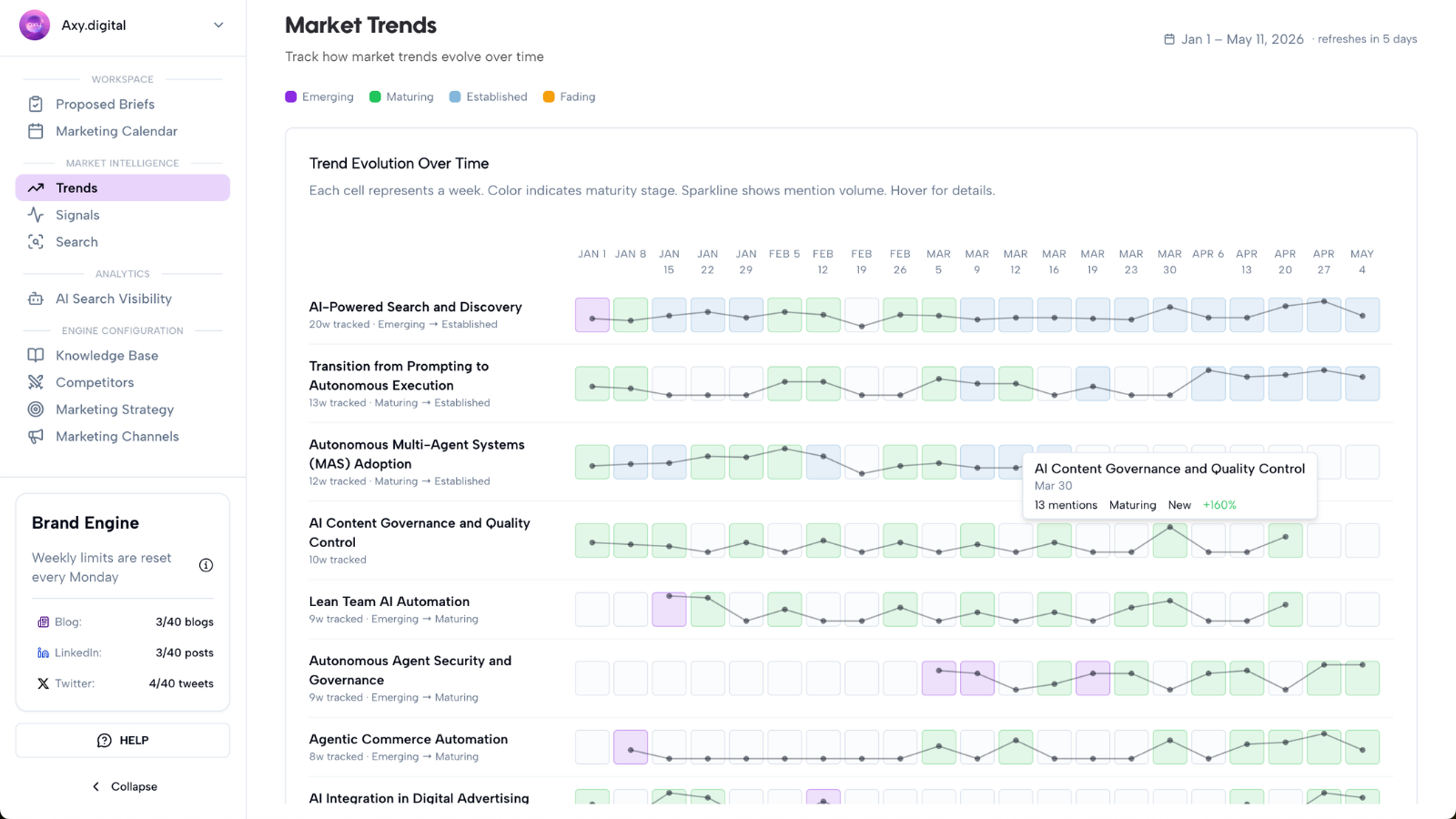
Step 1: Open Trends
From your Market Intelligence Dashboard, open the Trends section.
This section gives you a temporal view of how topics evolve in your space.
Axy.digital helps you understand whether a topic is:
- An early signal
- An emerging trend
- An established narrative
- A fading topic
- A recurring market concern
This helps you decide what kind of content to create and how urgently to act.
Step 2: Understand early signals
Early signals are weak but potentially important signs that a topic is starting to form.
They can come from:
- Niche discussions
- Early research
- Small search changes
- Founder conversations
- First competitor mentions
- Early social traction
- New questions from customers
Early signals are useful when you want to act before a topic becomes crowded.
They are often good for:
- Founder commentary
- X posts
- LinkedIn thought leadership
- Short exploratory content
- Early POV campaigns
Step 3: Understand emerging trends
Emerging trends are topics gaining traction across multiple sources.
A topic becomes more interesting when it appears across:
- News
- Research
- X
- Competitor content
- Search demand
- AI visibility gaps
Emerging trends are strong candidates for campaigns because the market is already paying attention, but the narrative is still forming.
They are often good for:
- GEO articles
- LinkedIn posts
- X threads
- Educational content
- Comparison content
- Product-led thought leadership
Step 4: Understand established narratives
Established narratives are topics that are widely recognized in your market. These are no longer early conversations. They are part of how buyers understand the category.
Established narratives are useful for:
- Evergreen GEO content
- Use-case pages
- Comparison pages
- Tutorials
- Category pages
- Case studies
- Pillar content
If a topic is already established, your goal is usually to build authority, clarify differentiation, and create content that is easy to find and cite.
Step 5: Identify fading topics
Some topics lose momentum. A fading topic is one that no longer shows strong attention, search growth, or market relevance.
You can still create content for a fading topic if it is strategically important, but it should not always be prioritized over growing opportunities.
Use fading topics to decide:
- What to stop prioritizing
- Which briefs to ignore
- Which content to refresh instead of creating from scratch
- Which narratives are no longer worth chasing
Step 6: Decide how to act on a trend
Different trend stages call for different actions.
Use this framework:
- Early signal: publish a fast POV or short social commentary.
- Emerging trend: generate a cross-channel campaign.
- Established narrative: create evergreen GEO content, comparison pages, tutorials, or use-case pages.
- Fading topic: deprioritize, refresh existing content, or monitor.
- Recurring concern: build a content cluster or recurring campaign angle.
Axy.digital uses these trend patterns to prioritize proposed briefs.
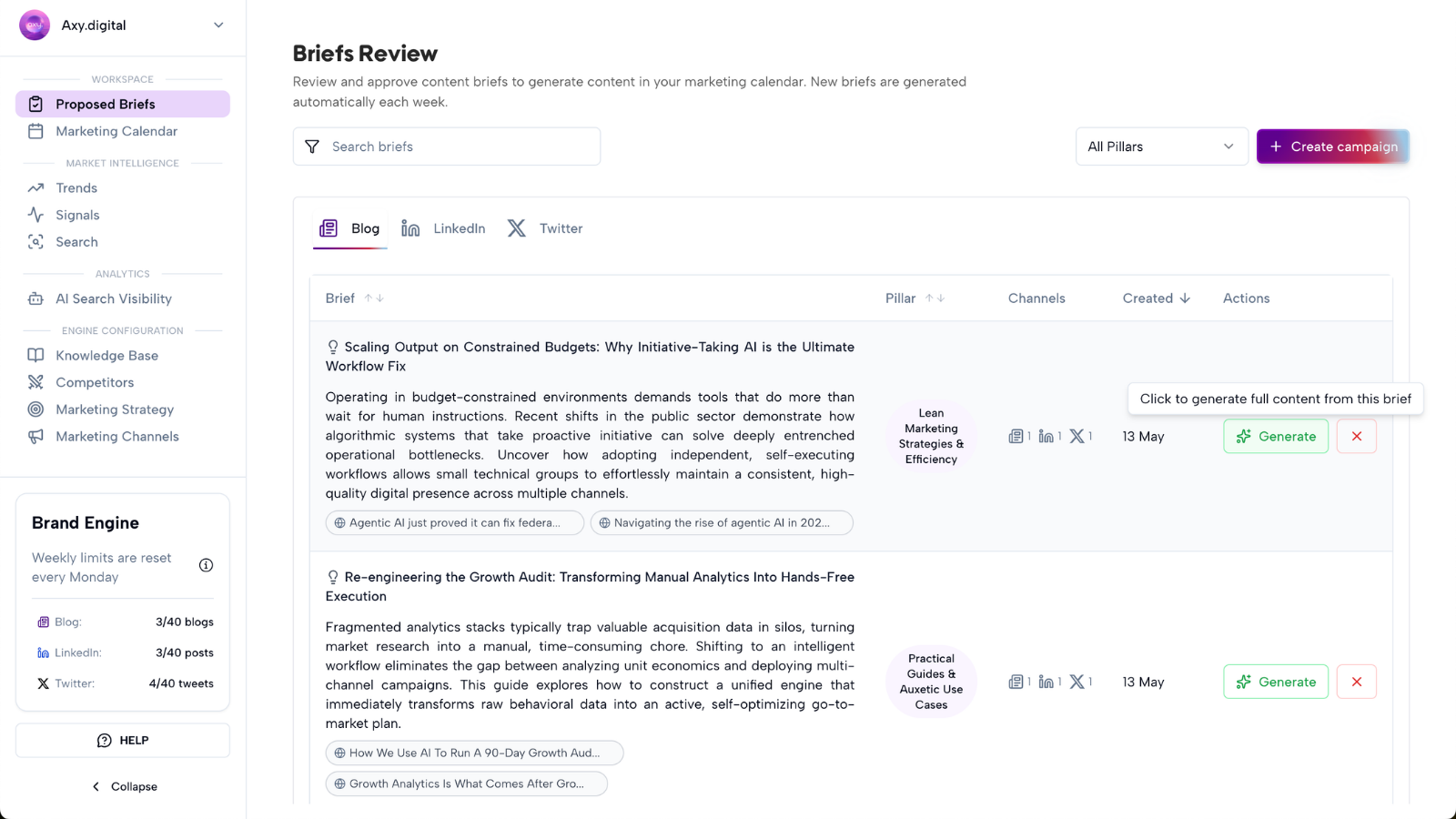
Step 7: Generate campaigns from trends
When Axy.digital identifies a trend worth acting on, it creates a brief in Workspace → Proposed Briefs.
Review the brief and click Generate to create the campaign.
Axy.digital uses:
- The trend
- Your strategy
- Your channel plans
- Your channel guidelines
- Your competitors
- Your knowledge base
- Your website index
- Search and AI visibility data
Generated content is moved to your Marketing Calendar.
FAQ
What is the difference between a signal and a trend?
A signal shows what your market is reacting to now. A trend shows how that topic is evolving over time.
Why does trend stage matter?
Trend stage helps you decide what kind of content to create. Early signals are better for fast commentary. Established narratives are better for evergreen content and authority-building pages.
Should I only act on emerging trends?
No. Emerging trends are often strong opportunities, but early signals and established narratives are useful for different reasons.
Where do trend-based campaign ideas appear?
Trend-based campaign ideas appear in Workspace → Proposed Briefs. Generated content appears in your Marketing Calendar.
Best practices
Match content format to trend stage
Do not treat every trend the same. Early signals, emerging trends, and established narratives need different campaign strategies.
Act early when your brand has a strong POV
Early signals can be powerful if you have a credible angle before competitors crowd the topic.
Use established narratives for evergreen content
Established narratives are good for GEO content, tutorials, comparison pages, and use-case pages.
Avoid chasing fading topics
If momentum is declining, make sure the topic still supports your strategy before creating new content.
Watch recurring concerns
Recurring concerns often reveal durable customer pain points and strong content opportunities.